
ICBA celebrates 50 years of serving open shop construction this year, and we are looking back every week at some of the significant moments, milestones, and people who helped ICBA become Canada’s largest construction association.
Today, we wind the clock back to the early 1980s and the most pivotal decision in government construction policy: Who will build Expo 86? This is the first of three parts.
The interviews and other original research on which the ICBA50 series is based were conducted by writer Kevin Hanson. We appreciate Kevin’s work capturing the people, events, and milestones that shaped ICBA’s first half-century.
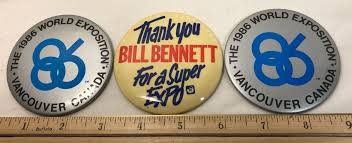
Expo 86 is widely regarded as a transformational event for Vancouver—the first time the region threw open its doors and introduced ourselves to the world.
But for the B.C. construction industry, it was even more pivotal. It changed the trajectory of construction labour for decades to come. ICBA open shop advocacy – bolstered by Building Trades overreach and arrogance – won the day.
 The directive came from Expo 86 Chairman Jimmy Pattison and may have originated with the premier himself: Show me you can do it. It was the summer of 1984, and time was already running short to get the world’s fair site built. Intense negotiations had been underway since at least March regarding the respective roles for union and non-union contractors on this massive and high-profile project. But the Building Trades had taken an “all or nothing” stance, and a deal to avoid further labour disruptions seemed increasingly unlikely. Meanwhile the growing capacity and expertise of the open shop sector were well past the point where they could be ignored.
An ad hoc, ICBA-aligned committee had already been in extensive discussions with Pattison – a prominent businessman with a one-dollar-a-year mandate to make Expo 86 a success. But he needed a clear demonstration of the size and commitment of the open shop sector. Bill Kerkhoff remembers Pattison telling the group: “I want to see all these other guys. I’m going to rent a ballroom, and you guys fill it up.” And he wanted it in less than a week, on Saturday, July 7, 1984.
“When we got the marching order, we got together our guys from ICBA,” Kerkhoff said. “We knew guys all around the province, and we all got on the phone and we started soliciting: ‘Listen, guys. This is crucial.’” The risk was high. “There wouldn’t have been anything worse than to show up there and have a half-empty room,” said Don Weitzel. But the response was strong and the room was packed – even if not everyone in it was ready to head down to the site and start swinging a hammer. “We stripped our office, we took everybody, even our secretarial staff and so on,” Weitzel – a benefits broker – recalled. A total of 90 firms registered at the event, and the mood in the room was incredible. “I tell you – the energy,” Larry Fisher said. “We could have powered the whole city for a year.”
It had the desired effect. “That was a tipping point. It was an epiphany,” said Weitzel. With a strong alternative clearly available, the Expo board’s interest in reaching an agreement with the Building Trades quickly dissipated – along with any risk that non-unionized contractors would be squeezed out of the Expo opportunity. The sector had proved its abilities and its determination to be treated fairly – in Kamloops, at Pennyfarthing, and over the course of many other projects. And on July 7 it convincingly demonstrated it could build a significant portion of the project that would redefine global perceptions of Vancouver and British Columbia.
The cover headline of the July 8 Province captured the confidence and determination that ICBA and B.C.’s open shop contractors were feeling at that heady time. It read simply, “We’ll Build Expo”.
Expo 86 was first announced in the 1980 Throne Speech and originally intended to be a modest transportation fair on the year of Vancouver’s centennial. But it evolved into a major global exposition, with 65 national and other pavilions on a nearly 70-hectare main site along the north and east shores of False Creek. Construction began in March of 1983, coinciding with a visit from Queen Elizabeth, who used the occasion to invite the world to Vancouver. It was a massive undertaking. British Columbia was suffering through an ongoing economic downtown, making the resulting jobs and economic stimulus highly welcome.
But the world accepted the invitation, and the fair was a resounding success, including remarkably cooperative weather during its five-month run. The original visitor projection number was 13.7 million, while actual visits hit 22.1 million. It left behind an infrastructure legacy that includes the SkyTrain, Canada Place, B.C. Place, Science World and the Coquihalla Highway. The site was sold afterwards to Hong Kong developer Li Ka-shing, sparking the transformation of a post-industrial wasteland into some of the city’s most vibrant residential and mixed-use areas. Pattison proudly summed it up this way: “Expo was an international success financially and culturally. The media called it the finest world’s fair on this continent since Expo 67 in Montreal. And it came in on time, under budget, and with no scams.”
Expo set a relatively homogenous and sleepy metropolitan area, with a population of a little over a million, on the path to the global-city status it enjoys today. “There’s pre-Expo B.C. and post-Expo B.C.,” said Norman Spector, who served as deputy minister to Premier Bill Bennett in the lead-up to the fair. Bennett himself was certainly cognizant of the legacy he was helping to create, predicting just before its opening that: “When Expo closes, you will see a surge of construction on the site far bigger than the fair itself and will confirm Vancouver’s reputation as one of Canada’s most dynamic cities.”
Before any of that could happen, though, the pavilions and other on-site facilities needed to get built. Just a few years prior, there would have been no question that a large, complex and publicly funded project of this kind would have been built building-trades only. And initially, it appeared that was the direction Expo would go as well. “In the beginning, Expo was to be a completely union-built fair,” as one pro-union observer put it. “There seemed to be no alternative.” Jimmy Pattison was of a similar view. At a meeting in October 1982, he told Building Trades President Roy Gauthier: “What we need is a no-strike agreement until the fair’s built. And for that, we’ll do a deal with the unions: it will be an all-union site.” (Remarkably and presciently, Gauthier was un-encouraging on the prospects for such a deal.) But the province’s open shop contractors were not prepared to let this opportunity pass them by – ICBA committed at its convention in November 1983 to press for open tendering at Expo – and this time around they had a resolute ally in the province’s highest office.
Premier Bill Bennett was determined from the outset that Expo 86 would be inclusive. Claude Richmond recalls the direction he received when he was made minister responsible: “You have to remember one thing, Claude, Expo is a fair for all British Columbians,” the premier told him. “And that’s the only parameter he gave me,” Richmond says – adding that he had no doubt that the notion of “all British Columbians” extended to opportunities to bid on Expo work. It was still a radical proposition at the time, but the strong Socred win in the 1983 election had changed the equation and, as Pattison put it, positioned the Bennett government to “play hardball”.
Competitive, open-shop bidding fit well with the dramatic restraint program introduced after the 1983 election, and which had sparked major confrontation with the province’s labour movement. It was also an opportunity to better manage Expo costs, and sat well with members of the public who saw union demands as out-of-step with the tough economic times (more than 200,000 were unemployed in B.C. in early 1984). The premier’s resolve was also buttressed by the events at Pennyfarthing, which he was determined to avoid a repeat of, and by his general concern with B.C.’s volatile labour relations environment and its impact on the economy.
Premier Bennett, Spector believes, looked at the question of who should build Expo through both an economic and a political lens. As a small businessman, “he wouldn’t understand this [union] price-fixing type of stuff,” and he would have recognized the advantage of reducing the influence of a group that had mobilized against him.
“As I look back on it, I think he saw Expo as an opportunity to make some major progress,” Spector says. Whatever his precise motivations were, the premier’s role was instrumental in ensuring Expo was built open shop. Longtime Vancouver Sun legislative columnist Vaughn Palmer has a two-word answer when asked what determined that outcome: Bill Bennett. “I don’t know if we’ve ever had anyone in the premier’s office with Bill Bennett’s will power,” Palmer said.