

ICBA celebrates 50 years of serving open shop construction this year, and we are looking back every week at some of the significant moments, milestones, and people who helped ICBA become Canada’s largest construction association.
Today, we wind the clock back to learn more about ICBA’s first staff member, Ralph Purdy.
The interviews and other original research on which the ICBA50 series is based were conducted by writer Kevin Hanson. We appreciate Kevin’s work capturing the people, events, and milestones that shaped ICBA’s first half-century.
In ICBA’s 50-year history, the organization has only had three presidents: Chris Gardner, Phil Hochstein, and Ralph Purdy.
It may be 50 years ago, but ICBA Board member Christina Koechl clearly remembers the hot summer afternoon when Ralph Purdy first walked into her office in Surrey, sat across from her in the large single room, and asked for her support in launching ICBA. “I can still see him with his straw hat entering,” she said – a straw hat that she was later given as a momento of her friendship with him.

Ralph Purdy
“He was a soft spoken man who came across very sincere,” Koechl said. “He had this ideology that things could improve, could be made better, but it needed numbers in order to get there. And he was right. He valued our support and validated our support. And that’s why we felt, yes, it makes more sense to have other people, other contractors band together and become one voice and form an association.”
The fondness and deep respect with which she spoke of Ralph Purdy – ICBA’s founding executive vice president – is common among the early members who worked with him and came to know him. They describe him as someone who had a quiet presence but nevertheless spoke authoritatively, and who brought a broad vision to the association. He was well versed on the labour code and related matters, but is most commonly remembered and described simply as a man of principle.
“He was totally convinced that he could change this situation here in B.C. because it was the right thing to do,” said Bill Kerkhoff.
“It’s really hard to put into words the impact that he had,” added Ken Funk. “He was the founder of a movement for sure.”
Born in Iowa, Purdy became a Canadian in childhood, and received what formal education he had in rural schools in the Melfort, Saskatchewan area. He served in the Canadian Air Force during World War II, and spent many years working in public relations, publishing and advertising management, including serving as editor of various prairie newspapers.
Although still Saskatchewan-based, he had had some association with the Vancouver Island Right to Work Association in the early 1970s. And it was Journal of Commerce coverage of a speech he gave in that capacity that first put him on Elmer Verigin’s radar screen – leading to an invitation to him to provide an evening keynote at the ICBA’s founding convention, and to his hiring shortly thereafter.
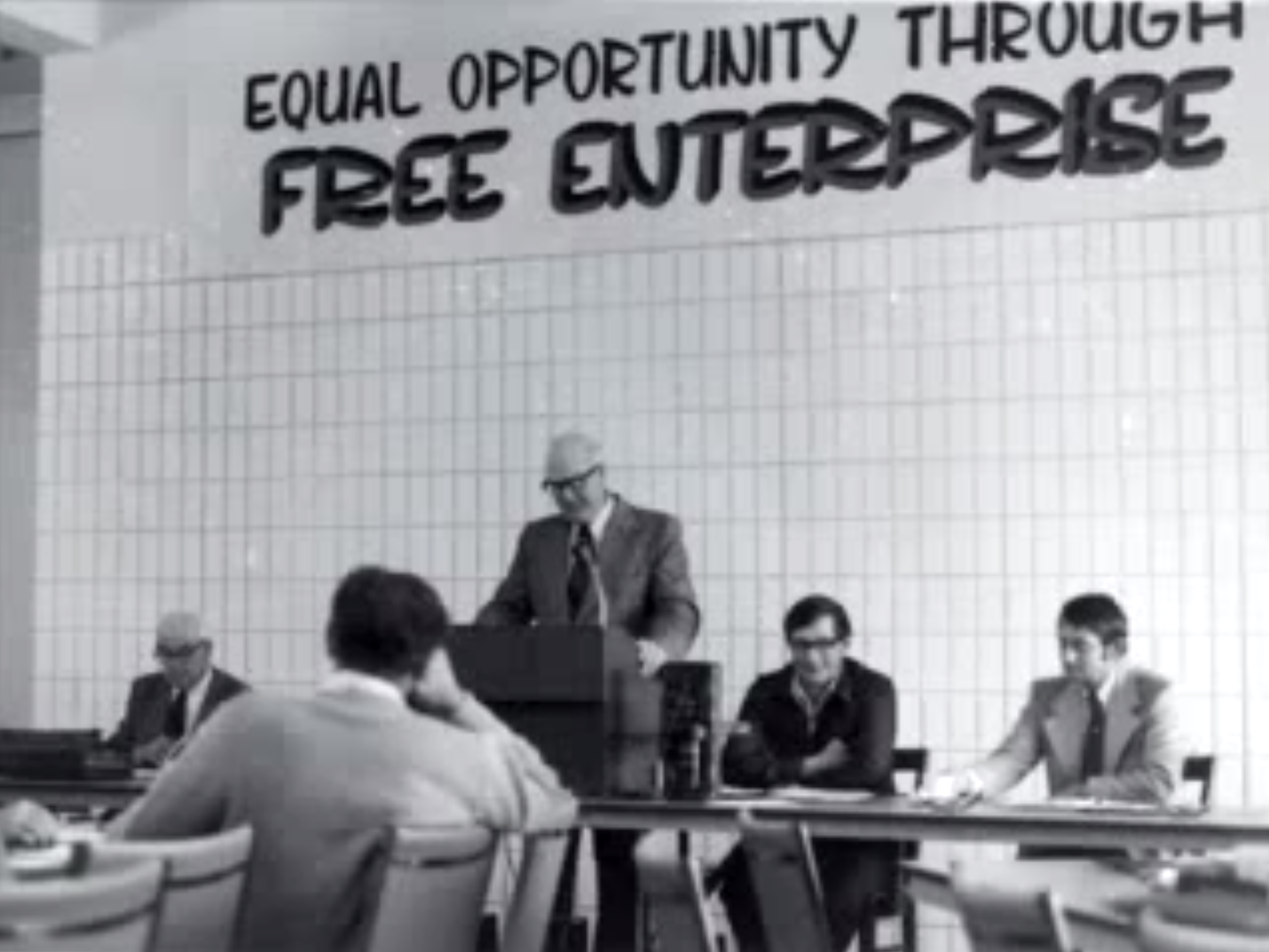
Ralph speaking at an early ICBA meeting.
Purdy was a strong proponent of “right to work,” believing individual employees should never be compelled to join, or financially contribute, to a union. This terminology was widely embraced by members in the early days of ICBA, and was also a hot topic of debate at the Social Credit Party convention of 1977. But the term came to be seen as both provocative and ill-fitting with Canadian labour relations realities. Over time, ICBA framed its core objective instead as “open shop” construction, meaning simply that bidding and job sites should be open to contractors irrespective of whether they are union or non-union, and also irrespective of which particular union they may be signed-up with.
More fundamentally, Purdy’s many writings, speeches and media appearances reflect deeply held beliefs in the central importance of individual autonomy, and of free enterprise and small business in particular. He was a strong proponent of the fair treatment of employees and of profit sharing. And he had great disdain for what he frequently saw as the heavy hand of both big government and big labour. As Verigin put it in the eulogy he delivered at Purdy’s funeral: “This man believed in the supreme dignity of mankind and man’s individual freedom from all kinds of oppression.”
He was a fearless and optimistic defender of the open shop sector, frequently doing so in the challenging format of open line radio. (Host Bill Williams noted during a 1983 show with Purdy that the call lines had been jammed from the moment they sat down.) “He was able to articulate so well what we knew were the values and ideals of most people,” said Ed Rempel in a note to Ruth Purdy shortly after her husband’s death in 1992, at 84 years of age.
At the 1977 convention, Purdy spoke of insidious threats to freedom of action: “Too many of us have lost the will to depend on our own talents and skills. We have been drugged and hypnotized into becoming ‘dependent’ instead of ‘independent’. And, let me make it perfectly clear that being ‘independent’ doesn’t mean you have to become a heartless, self-centered individual without compassion for your fellow man. Just the reverse, it can mean that you are in an even better position to render help.”
He was an ardent promoter of the advantages of open shop for construction, writing in a 1983 paper: “Qualified open shop firms can finish jobs on time and on budget. They aren’t saddled with a host of feather-bedding clauses and forced to pay for many hours of unproductive time. Neither do they have to provide untold thousands of dollars unions spend on causes completely unrelated to collective bargaining and employee benefits.”
And visionary as he was, he could also distill the principles he and ICBA promoted down to their practical essence. “It’s just a question of getting down to logic and common sense,” he told one radio host. “In our association we say that economic progress is achieved through cooperation not confrontation.”

Front row: Ralph and Ruth Purdy, at Ralph’s retirement celebration.
Purdy toiled long and hard for the association, and for very limited financial reward. This selflessness was on display immediately after the founding convention, when he declined the offer of share of the modest surplus the event had produced. Rather than accepting this monetary acknowledgement of his contribution to its success, he preferred the money be used for ICBA purposes.
In 1977, Purdy was well past the usual retirement age and earning a modest $18,000 annually, plus car and expense allowances – little better than half what the B.C. Federation of Labour was paying its senior staff member at about the same time. Money sometimes wasn’t available to pay what was due, and Purdy sometimes used what he did receive to cover ICBA costs. Some of the special financial contributions early members made were specifically to ensure Purdy got at least some income.
In 1991, at a point when ICBA was on a stronger financial footing, Purdy’s impact and personal sacrifice were recognized with a special $50,000 payment “for unpaid past service.” Former chair Roy Moor urged board members at the time to bear in mind Purdy’s “undying devotion to the association”, his monumental efforts on its behalf, and the “embarrassing low wages he received when we just didn’t have the funds.” The payment was presented at a barbecue in Purdy’s honour in Ladner.
The money no doubt made a considerable difference over what proved to be the final few months of Purdy’s life, and for his widow Ruth. For the man himself, however, his legacy surely remained more important than any financial reward. Speaking at Purdy’s funeral, Chairman Mark Gauvin said Purdy was both the founder of the open shop movement in British Columbia, and that he had nurtured it into the force it had become. “I shudder to think of our predicament today,” Gauvin said, “had Ralph not agreed many years ago to come to the coast and give foundation and life to an idea that has become ICBA.
For their contributions to ICBA and open shop, both Ralph and Ruth Purdy were honoured with Life Membership, ICBA’s highest honour.

