
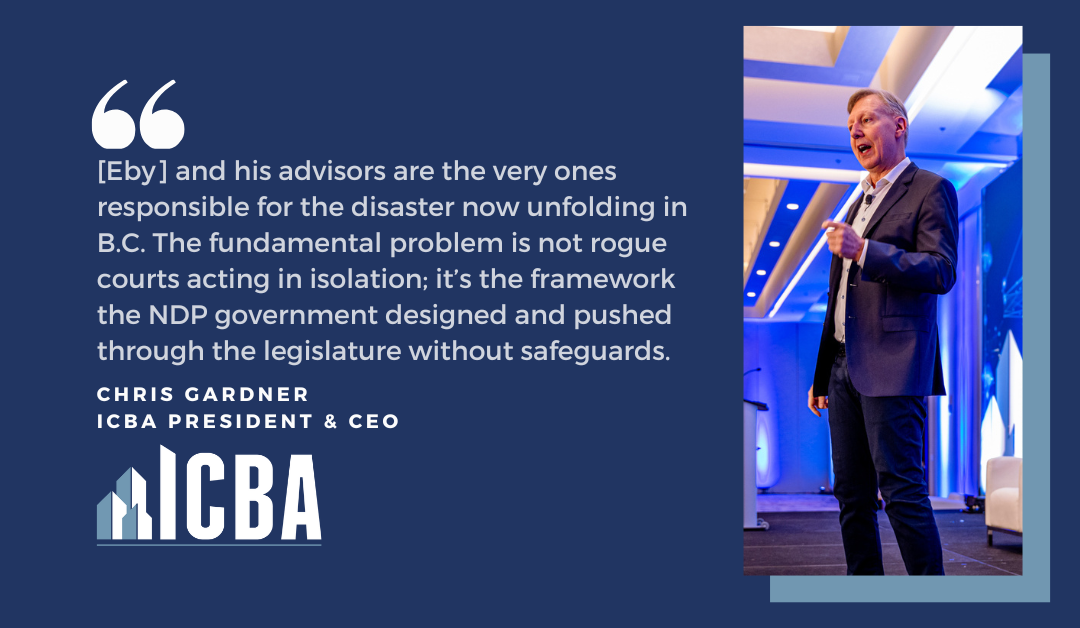
The following op-ed, written by ICBA President and CEO Chris Gardner, first appeared in Northern Beat on December 12, 2025.
Like an arsonist giving a heartfelt speech about the importance of fire safety, while the building he lit is still burning behind him, Premier David Eby he told business leaders this week that the legal framework his own government created is now threatening to “undo” British Columbia as a place to invest.
On one hand, the Premier boasts that more than $100 billion in projects are advancing thanks to his government’s “one special trick”: equity deals and “strong partnerships” with First Nations. On the other, he admits that recent court decisions tied directly to Declaration on the Rights of Indigenous Peoples Act (DRIPA) and UNDRIP are “overreaching,” “unhelpful,” “toxic,” and could destabilize the investment climate and erode public support for reconciliation.
You cannot fundamentally rewire the legal foundation of the province, bolt a vague UN resolution onto every statute, hand judges a new interpretive super-tool, and then act shocked when courts use it in ways you don’t like. Yet that is exactly what has happened with DRIPA and section 8.1 of the Interpretation Act.
The Court of Appeal’s Gitxaala decision made this crystal clear: DRIPA is not symbolic. UNDRIP is now a legal measuring stick – thanks to Eby’s own government. It is a risky constitutional experiment with the livelihoods of hundreds of thousands of British Columbians.
It is a five-alarm fire. You can follow every rule on the books today, secure your approvals, invest millions, and then discover years later that a court has decided those rules “mean something different now” because of how it chooses to read UNDRIP. That is not reconciliation; that is regulatory roulette.
Only now does Eby concede how damaging this uncertainty has become. He describes the Cowichan title ruling and the DRIPA/UNDRIP Court of Appeal decision as deeply complex, overreaching, and toxic to the very reconciliation work he claims to champion. He worries about endless litigation, confusion over private property, and uncertainty that could be the “undoing” of British Columbia as a place to do business.
But the problem is not rogue courts acting in isolation; the problem is the framework his government designed and pushed through the Legislature without safeguards. British Columbians were told DRIPA was about symbolism and frameworks. The courts have now told us it is hard law with sweeping consequences. If you change the rules of the game and then hand the referee a new rulebook, you can’t complain when the calls go against you.
Eby now insists that “any reconciliation has to respect private property, period,” and promises to “go to the wall” for fee-simple homes and industrial lands. This raises an obvious question: if private property is non-negotiable, why wasn’t that made crystal clear when DRIPA and section 8.1 were drafted and passed? Instead, homeowners, farmers, ranchers, and business owners are left watching court cases to find out what their title really means.
Rather than own these mistakes, the Premier now suggests judges have misunderstood the Legislature’s intent, and caricatures critics of DRIPA as wanting to “shut the door” on First Nations. That is a false choice. ICBA has been explicit: respecting both Indigenous and property rights matter, and creating prosperity for all must be the goal. The issue is not whether we work together; it is how we build a framework that delivers clarity and stability for everyone.
There is a better path. First, recall the Legislature and repeal DRIPA. Second, repeal section 8.1 of the Interpretation Act so courts interpret B.C. laws based on the text passed by elected MLAs, not on an evolving UN declaration. Third, reinvigorate a modern treaty process that provides real certainty and finality for everyone – First Nations, governments, and the private sector. Finally, put robust protection for fee-simple private property at the centre of B.C.’s legal architecture so no homeowner or business owner has to wonder who really owns the land they paid for.
Layering DRIPA, UNDRIP, and section 8.1 on top of an already complex constitutional structure has created an unstable legal, investment, and business climate that will slow or stop everything we need to build. The NDP’s dangerous experiment must be stopped and replaced with a practical, constitutional approach that respects the rights of all British Columbians.
The Premier now wants credit for promising to put out the fire. The first step is to admit who struck the match – and then to repeal DRIPA, scrap section 8.1, and rebuild a reconciliation framework that delivers what builders, workers, and Indigenous communities all need: clarity, certainty, protection of private property rights, and a durable path to “yes.”
