
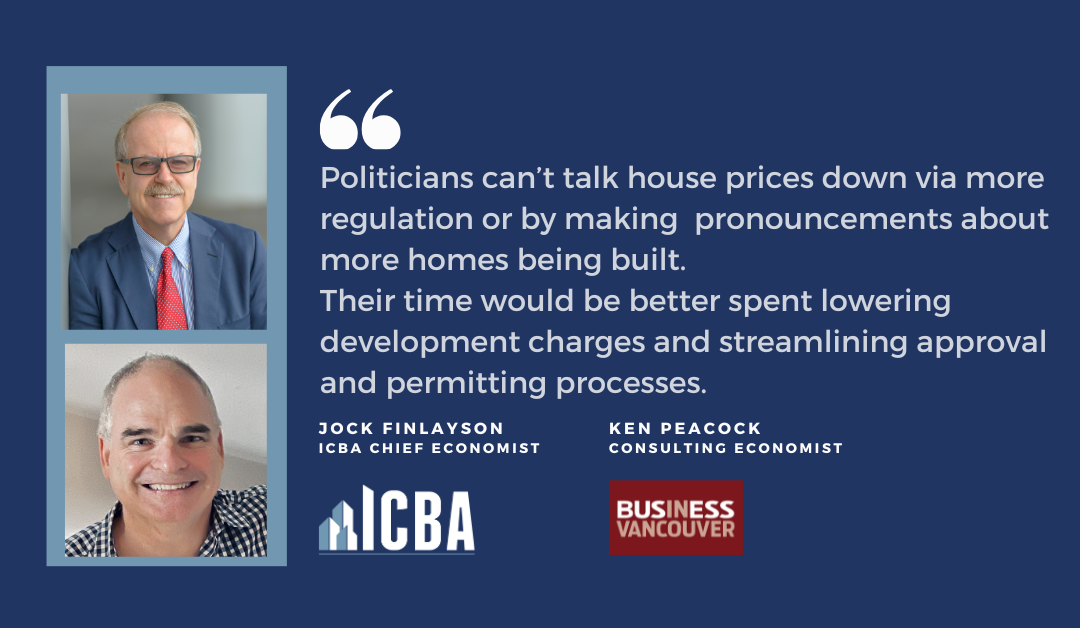
The following op-ed, by ICBA Chief Economist Jock Finlayson and consulting economist Ken Peacock, was first published by Business in Vancouver on November 24, 2025.
Even amid notably sluggish market conditions, Metro Vancouver continues to have the most expensive housing in Canada. True, falling prices, lower interest rates, and modest income gains have recently improved affordability, especially for condos. But absent significant financial help from family, single family homes remain far beyond the reach of most first-time buyers.
The Royal Bank tracks affordability across all Canadian metros. Its latest report shows Vancouver and Victoria (and Toronto) recording the largest price declines, leading to the biggest reductions in home ownership costs.
Even so, Metro Vancouver still ranks as Canada’s the mostly expensive housing market. According to RBC’s October report, ownership costs (which assume a 20 per cent down payment and a mortgage at the prevailing 5-year rate) for a single-family home consume 126 per cent of median pre-tax household income. In Victoria the ratio is 79 per cent, less daunting but still challenging for many buyers.
Condo ownership is more attainable. Purchasing a condo in the Vancouver area now absorbs 48 per cent of average pre-tax household income, down from 60 per cent in late 2023 and early 2024. In Greater Toronto the figure is 37 per cent; in Calgary, it’s just 22 per cent. With cheaper housing and better job prospects, it’s little surprise that record numbers of British Columbians are migrating to Alberta.
Despite some gains, home sales remain subdued in Metro Vancouver, the Fraser Valley and Victoria, suggesting prospective buyers anticipate further price declines. In October, home sales in the Greater Vancouver Real Estate Board area were 14 per cent lower than a year earlier and 14.5 per cent below the 10-year average. Listings, by contrast are abundant, up 13 per percent y/y and 36 per cent higher than the 10-year average.
The Fraser Valley Real Estate Board reports similar conditions, with sales down and active listings up. The combination of more inventory and fewer sales has tilted the market in buyers’ favour, putting sustained downward pressure on prices across all housing types.
Ultra low interest rates were central in propelling Metro Vancouver home prices to record highs in 2022, but demographics also played a role. In-migration surged over 2017-2024 (with a temporary pause in 2020). Today, the largest 5-year age cohort in Metro Vancouver is aged 30-34, and there are 811,000 people aged 25 to 39 – the prime household formation years. Since 2019, this millennial cohort has grown twice as fast as the region’s overall population.
Demographic forces suggest home sales should eventually revive as immigration levels rebound post-2028. Further improvements in affordability would also support a sales upturn. For now, this will have to come via some combination of lower interest rates, lower or at least flat sales prices, and increases in household incomes. Mortgage rates may ease a bit over the next year, but strong income growth is unlikely. The most feasible path to greater affordability in the next 2-3 years is through continued price softening.
New housing supply should reinforce that trend. Roughly 4,000 new homes have been completed each month in Metro Vancouver recently, nearly twice the average since 2010. Victoria shows a similar pattern. With 63,000 dwelling units under construction in Metro Vancouver, buyers are enjoying more choice and the luxury of time to scout out better deals.
Yet despite political rhetoric about “building more homes,” B.C.’s residential construction sector is poised for a downturn. The provincial government predicts that housing starts will increase marginally in 2026 before posting another 7 per cent gain in 2027. That forecast looks badly out of touch given current market conditions, mounting layoffs in the development industry, and an ever-expanding list of cancelled multi-family construction projects. Province-wide, we see urban housing starts coming in around 35,000 next year, with a further drop possible in 2027; this compares to the 43,000 and 47,000 starts assumed by the Ministry of Finance in 2026 and 2027. A period of depressed starts will set the stage for a return to spiking prices later in the decade.
Persistently high housing costs are more than just a social concern. Unaffordable ownership options are feeding escalating outmigration, draining talent and eroding B.C.’s competitiveness. Market forces may gradually restore some balance, but over the medium-term high housing costs will continue to weigh on recruitment and retention and hamper business growth in the lower mainland.
Provincial and municipal politicians can’t talk house prices down via more regulation or by making repeated pronouncements about more homes being built. Their time would be better spent lowering development charges and streamlining approval and permitting processes.
