

ICBA celebrates 50 years of serving open shop construction this year, and we are looking back every week at some of the significant moments, milestones, and people who helped ICBA become Canada’s largest construction association.
Today, we wind the clock back to the 1980s and a key decision by a major construction company to leave the unions.
The interviews and other original research on which the ICBA50 series is based were conducted by writer Kevin Hanson. We appreciate Kevin’s work capturing the people, events, and milestones that shaped ICBA’s first half-century.
In the 1980s B.C. labour environment, ICBA might well have taken a “pull up the drawbridge” attitude, and left the unionized contractors to their own devices, but it did not. “Making the family bigger was better for everybody really,” says Phil Hochstein, in reference to a 1985 Labour Relations Board application ICBA supported.
Concerned Contractors Group was a bold attempt to convince the Board to re-consider how to deal with successorship and common employer applications. Its existing approach was premised on the bygone reality of an almost entirely unionized construction industry, argued Gall, and it threatened the survival of unionized contractors. He illustrated the fundamental change that had happened by noting that it was very rare “for any union company to obtain a contract of five million dollars or less in the public tender market and this dollar amount is rapidly moving upward.”
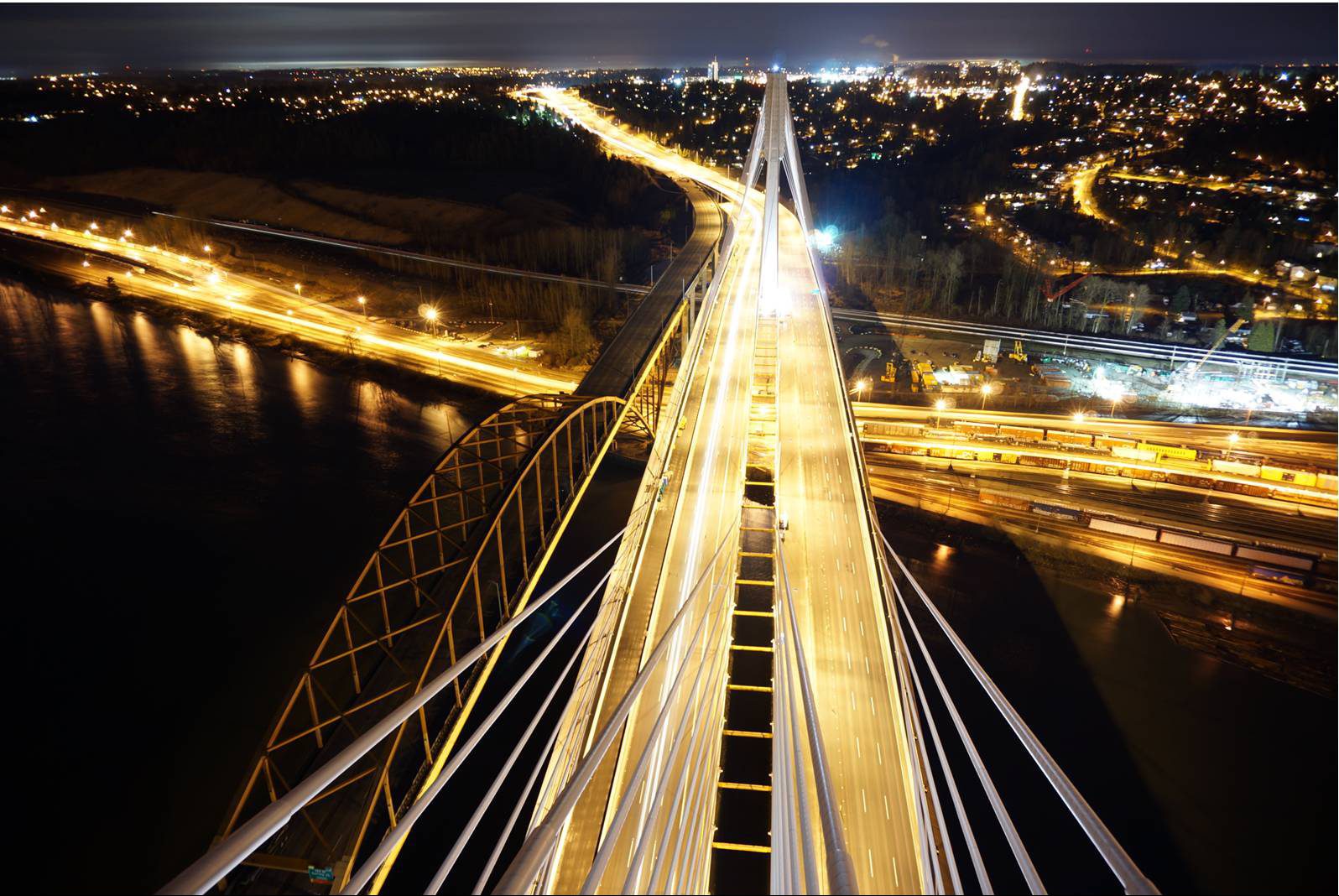
Two decades after going open shop, Kiewit built the spectacular Port Mann Bridge
Among the specific asks was that the principals of a failed company should be able to start new ventures without being bound by the union obligations of their previous company. “No one was happy with that, even on our side,” says Hochstein, “that someone could sign a collective agreement and be stuck with it for their entire career if it didn’t make any more sense.” But the argument was a bridge too far for the Labour Relations Board at that time. Gall says he and ICBA knew going in that the application wouldn’t succeed, but says it was treated seriously by the Board and increased the pressure for further Code reform.
The Code had been regularly amended by both NDP and Socred governments, with particularly significant changes in 1984 and 1987. The 1984 amendments included provisions allowing for the division of the Expo site into legally distinct zones, thus enabling its construction to proceed open shop. They also allowed for cancellation of a collective agreement where there had been no employees in a bargaining unit for two years.
An even broader set of amendments in 1987, under Premier Bill Vander Zalm, put further constraints on successorship and common employer findings. The Code was also renamed the Industrial Relations Act, and an Industrial Relations Council replaced the Labour Relations Board. Don Jordan played a significant role in drafting these amendments, and says they were “largely intended to put more individual rights into the Code, period.” They nevertheless encountered strong pushback from the labour movement and NDP Opposition, with more than 250,000 workers walking off the job in protest on June 1, 1987, and shutting down various public services.
Openings such as the one created by the “two years and out” rule were not something that was contemplated lightly, but did prove to be a viable pathway towards an open shop future for some.
Frank Margitan says Peter Kiewit Infrastructure realized it could no longer compete as a building trades contractor after seeing Kerkhoff Construction win bids for the Great Bear Snow Shed on the Coquihalla and the Skytrain extension bridge over the Fraser River. Kiewit crunched the numbers and realized the labour cost differential was an unsurmountable barrier. Appeals to the building trades, even at the international level in Washington, were ineffective.
So Kiewit made the decision to stop work in B.C. for the required two-year period. “We still had an office here but we had no active construction work in the province,” Margitan says. “But the gain after that was substantial because you know, you go and build these projects like Port Mann [Bridge], Sea-to-Sky [Highway], Pitt River [Bridge] – we would not have gotten those jobs on a building trade platform.” Kiewit did, however, build these projects under collective agreements – but agreements that came out of a very different labour relations model that also emerged as a major factor in B.C. construction in the 1980s.

