

ICBA celebrates 50 years of serving open shop construction this year, and we are looking back every week at some of the significant moments, milestones, and people who helped ICBA become Canada’s largest construction association.
Today, we wind the clock back to the early 1980s and the most pivotal decision in government construction policy: Who will build Expo 86? This is the third of three parts.
The interviews and other original research on which the ICBA50 series is based were conducted by writer Kevin Hanson. We appreciate Kevin’s work capturing the people, events, and milestones that shaped ICBA’s first half-century.
On August 14, another major Expo 86 contract went non-union – this time to Marbella Pacific Construction, a newly formed joint venture involving Elmer Verigin of Trail and the Rempels of Abbotsford. This both entrenched the non-union presence, and acted as a catalyst for a final resolution of the labour tensions. When the Marbella crews arrived later in the month, the Building Trades invoked their non-affiliation clauses and walked out. The Labour Relations Board was then asked to determine whether Expo was a single construction site – in which case the non-affiliation clauses applied – or multiple sites. Gavin Hume argued the latter on behalf of Expo, but he was going to lose. The Expo site was clearly visible through the windows of the Board’s main hearing room, and it was self-evident that it was a single site. “If they [the panelists] turned around and looked out the window, the best evidence was what was out there,” says Hume.
But the common-site hearing was about to become irrelevant. On August 24, the Bill Bennett Government legislation enabling the division of the Expo site into legally distinct zones was proclaimed. Hume was given advance word of this by Jimmy Pattison, and informed the panel when it re-convened on August 25 – although he was told he inadvertently signaled something was up the day prior when he stopped his usual practice of taking detailed notes during the hearing. It’s been speculated that the proclamation was driven by a successful union application for the production of Expo board minutes, and it did have the effect of preventing that. But more importantly, it was the “move that ended all discussion” on the union/non-union issue, and definitively turned Expo into an open site.

China’s Expo 86 pavilion — built open shop
Their legitimacy now assured, open shop contractors rose to the challenge of completing complex tasks under close scrutiny. Elmer Verigin says his crew took on their most daunting job first – the Chinese pavilion. The challenges began with the novelty of floating pickets off Point Grey, although these proved ineffective at preventing barged materials from getting in. The actual erection of such a structure was new territory for his crew, and he says they approached it as an “operations research-type situation,” deciding to assemble the structure on the ground and then lift it into place with multiple cranes. To lessen the potential for critical spectators, this was done on a weekend. There was some trial and error, but “Monday morning everybody came there and the whole Chinese pavilion was up,” he says. A supervising engineer expressed concern over the lack of a pre-approved erection procedure, to which Verigin says his general manager replied: “We’re going to raise the other one tomorrow. Maybe you can come here and watch how we do it, or we can take this one down if you like and you can watch how we put it back up again?” The pavilion stayed up.
Work largely proceeded smoothly from the time the zones were implemented. Jimmy Pattison described seeing the “odd skirmish” during his daily site visits but said that “the rank-and-file guys got along fine.” So the possibility that the non-union sector might have to step up and completely displace unionized workers never materialized. Some will admit to skepticism today as to whether the non-union sector would actually have been able to do so – although Larry Fisher stood by the belief that it could have. “I mean we’d have been standing on our head a few times, but we would have definitely done it, yeah no question,” he said. Pattison estimated that 70 per cent of the contracts awarded in the final few months of construction went non-union, but that overall 70 per cent of the fair was built union. But from at least from 1984 onward, unionized contractors faced open shop competition on the bids they won, and they did not have the benefit of a guaranteed portion of the work.
There’s tremendous pride among those who made the open shop case, and those who earned the opportunity to help build the fair. “It was such an accomplishment, you know it was a beautiful display of construction, it was a beautiful display of architecture, and it was a fine show,” said Fisher, who was among the regular fairgoers in the summer of 1986. “It was just magnificent.” Added Axel Gringmuth: “In my life that was the most beautiful experience – I did the Italian Pavilion there and a lot of our other companies, other members did other things there. After that one [Expo] the province just exploded and you know our esteem went up.”
There’s also wide agreement that it was a decisive turning point for the open shop sector. “Expo is a continuing legacy. The province’s non-union sector has been immeasurably strengthened. And concomitantly, the building trades are weaker,” concluded pro-union reporter Rod Mickelburgh in his account of Expo. Said Wilson Beck: “Expo 86 was the turning point for the non-union general construction industry in B.C. It became very well known to… the buying public of construction, to the investing community, that these guys were professional, qualified contractors.” It was not, however, a pre-ordained outcome.
Expo would not have unfolded as it did without the efforts of Fisher and others, and the active support they received from ICBA; and the outcome would certainly have been different without the resolve of Premier Bennett. Yet even at that, Expo work could still easily have remained overwhelmingly in union hands. “These guys dug in, they dug their own hole,” said Gringmuth. “Bill Bennett had the spine to push back and that’s what eventually changed the whole construction-business picture in the province.”
Union hubris, in other words, made Expo a turning point. Vaughn Palmer says it may be understandable that the Building Trades acted as they did, since they hadn’t previously had a lot of need to make concessions. But by Expo, times and leadership were different. “The Building Trades overplayed their hand and with the consequences that they still live with today,” Palmer said. “They’re just not the force they were.”
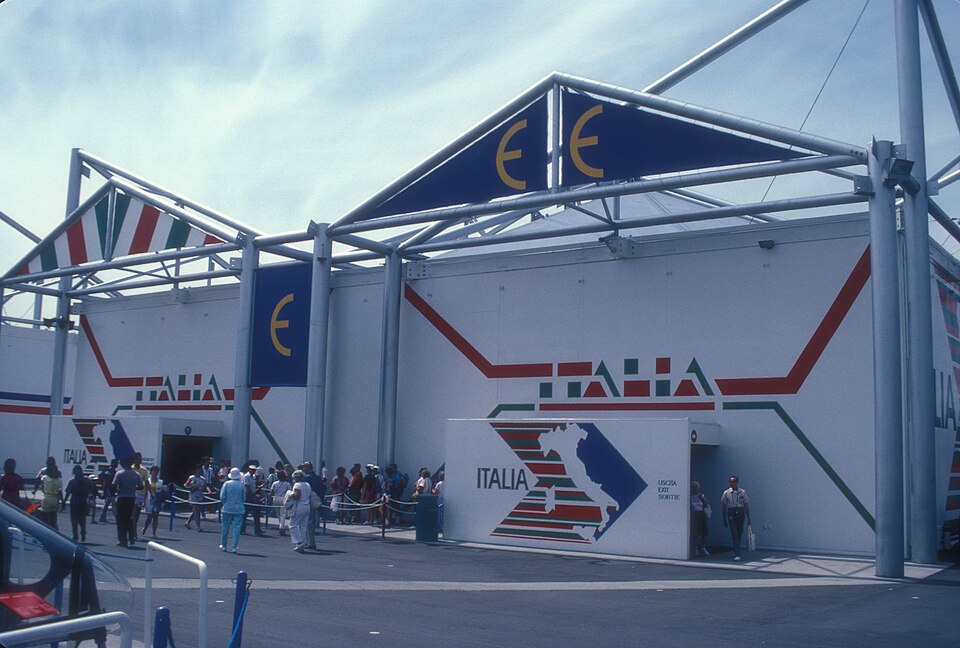
Italy’s Expo 86 pavilion — built open shop
