

ICBA celebrates 50 years of serving open shop construction this year, and we are looking back every week at some of the significant moments, milestones, and people who helped ICBA become Canada’s largest construction association.
Today, we wind the clock back to the early 1980s and the most pivotal decision in government construction policy: Who will build Expo 86? This is the second of three parts.
The interviews and other original research on which the ICBA50 series is based were conducted by writer Kevin Hanson. We appreciate Kevin’s work capturing the people, events, and milestones that shaped ICBA’s first half-century.
In late 1983, the Building Trades were privately informed by an Expo executive that the fair was going to be built open shop, and low non-union bids began to be accepted on smaller contracts. By at least March 15, 1984, Premier Bill Bennett was openly declaring that: “B.C. is open, B.C. is an open site, ever since we became government. There was only discrimination against ordinary British Columbians during the [NDP-governed] years ’72 to ’75. That discriminatory legislation is gone.”
Efforts to come to an agreement with the Building Trades to ensure labour peace nevertheless continued, and the premier raised the prospect of a ruined world’s fair if it couldn’t be secured, bringing things into much sharper focus through a televised address on March 29. Bennett set the context by saying the growth of the non-union sector was “an example of the market in action, a gale of competition in a previously insulated environment,” adding later that “success will not come from a return to attitudes and practices that may have served us well at other times and under other conditions.” He informed viewers all new Expo contracts had been frozen, and that he was giving Jimmy Pattison 10 days to provide his assessment of whether or not the fair could proceed. “But the bottom line,” the premier reiterated, “is that there will be no discrimination in British Columbia based on union or non-union status. There must be opportunity for all to work and surely Expo will create enough work for all to share.” With understatement, he added that cancellation of the fair would be “greatly disturbing.”
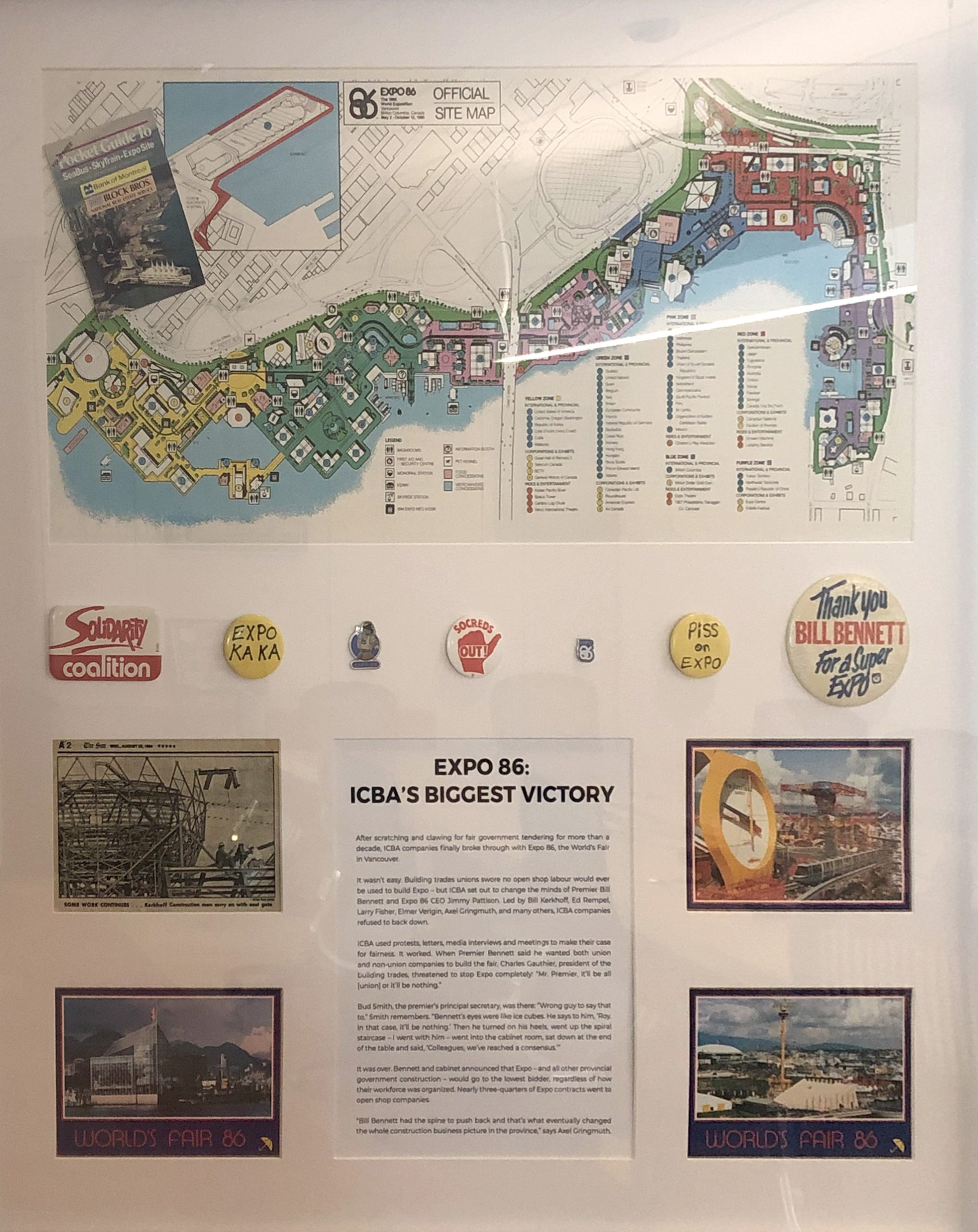
This collection of Expo buttons — including angry ones from union protests — is framed in ICBA’s office.
Many saw this as a strong but necessary stance. “The government could not even consider blacklisting an entire body of non-union workers in the name of labour peace. It is to be hoped all sides can find a way to keep the project alive,” the Globe and Mail editorialized. It was also effective politics, Bennett’s advisors say. “Up the pressure,” is how Norman Spector described the objective. “If Expo was cancelled, they [the unions] were going to have a bag of shit on their laps.” Bud Smith, the premier’s principal secretary at the time, said government polling confirmed strong public support for Expo, despite the critical viewpoints that were widely reflected in the media. “The public research was telling us that in spades,” Smith said. “They wanted Expo and they didn’t like people who seemed to be standing in the way.”
On April 6, Pattison announced that no agreement had been reached, and on April 11, he was ready to make his recommendation to cabinet. Both Spector and Bob Plecas, another of Bennett’s senior advisors, say the delivery of that recommendation was pre-arranged – although Don Jordan, who was working closely with Jimmy Pattison on the premier’s behalf, had no advance knowledge of how the dramatic day would unfold. When Pattison arrived at the office at about 8 that morning, he told Jordan to accompany him, saying only “you’ll see,” when asked where they were going. The trip involved a flight to Victoria and ended with the two of them knocking on the door of the room where the cabinet was meeting. “Would you tell Premier Bennett that Jimmy Pattison is here, and I’d like to see him, I’d like to speak to cabinet,” Jordan recalls Pattison saying to the sergeant-at-arms. Pattison emerged grim-faced 90 minutes later, to tell reporters what he’d told cabinet – that Expo “should be abandoned because of the possibility of labour disruption.”
Bennett took care to hold out hope of salvaging the fair that day, despite the Pattison recommendation, and hinted at a legislated solution. Nevertheless, “a tidal wave of reaction rolled over the province,” in response to the now very-real seeming threat of cancellation, and there was strong public support for the government’s position. The premier consulted widely with a parade of stakeholders who he called into his office during this crucial period, including legendary labour leader Jack Munro. “And none, not a single one, said don’t go ahead,” Smith recalled. A mood of uncertainty gripped the Expo offices, where the “telephones were silent and workers subdued,” but further developments were unfolding that would put Expo back on a track to completion.
The pivotal event took place on April 12, in Bud Smith’s office in Victoria. The key participants were Norman Spector and Roy Gauthier, President of the Building Trades Council. Smith was also present for portions of this day-long effort to salvage some sort of deal. On the table was the offer that the Building Trades would be guaranteed the large bulk of the Expo work, provided they agreed to a minority portion going to non-union contractors. “Which, if you think about it,” Smith said, “would have kept them in that game forever, being able to have some guarantee that public sector work is going to go union. It would have kept the precedent going.” A cabinet meeting had been happening at the same time upstairs and at about 6 p.m., Smith said, the premier came downstairs. “Okay, you guys have had all day at this,” he told the group. “This isn’t complicated.” Smith relates the exchange that followed:
“So Gauthier says in his best Scottish brogue, ‘Mr. Premier, it’ll be all or it’ll be nothing.’ Wrong guy to say that to. Bennett’s eyes were like ice cubes. He says to him, ‘Roy, in that case, it’ll be nothing.’ Then he turned on his heels, went up the spiral staircase – I went with him – went into the cabinet room, sat down at the end of the table and said, ‘Colleagues, we’ve reached a consensus.’”
For Spector, the image that stays in his mind was the look on Gauthier’s face: “It was white, looked like a ghost.” Gauthier had good reason for his sudden alarm. At that moment, Smith says, “the union leadership destroyed for themselves the ability to have any semblance of a mandatory union presence on government work.” The incident still stuns Smith: “To tell the premier that something will be all or nothing was actually mind-boggling to me. It was gobsmacking. And quite honestly, he [Gauthier] gave the choice. Either everything or nothing, and he got nothing.” Smith considers it one of the most “colossal miscalculations” in the history of the B.C. labour movement. Claude Richmond agrees: “If he’d have known anything about Bill Bennett – and you should know who you’re negotiating with – you know you don’t back him into a corner, ever.”
Bennett moved quickly and decisively. On April 13, he announced during a live televised press conference that Expo 86 would go on. “The government will be introducing legislation to ensure that no one, whatever their motivation, has the power to impede the operation of Expo 86,” Bennett said. This legislative backstop was introduced on May 8. Likened by the NDP to a declaration of martial law, it sparked several one-day protest walkouts at the Expo site. The essence of it was the ability to divide the site into legally distinct zones, which effectively nullified union non-affiliation clauses. Negotiations regarding minimum wage levels for Expo construction continued, but Gauthier now had to conduct them with a “gun at his head” in the form of the ability (still un-proclaimed for the moment) to divide up the Expo site and remove the unions’ key leverage, as described by Mickleburgh. Those efforts extended into the early summer but produced no acceptable agreement. One attempt was so close to success it was taken to a cabinet meeting at Cowichan Bay, but foundered when it was realized the intent to tie wages to an average rate of increase referred to as “CSP” had been miscommunicated as the higher consumer price index or “CPI”. “Three little letters, CSP versus CPI, made a huge difference,” said Don Jordan. Subsequent efforts to broker a deal by Graham Leslie, the deputy minister of labour, and Chuck McVeigh, head of the Construction Labour Relations Association, were similarly unsuccessful. In the wake of that final failure, the Building Trades threatened to campaign for an international boycott of Expo.
Meanwhile, the open shop sector was mobilizing. Various meetings took place between Expo and key contractors, albeit very discretely. Myrtle-Anne Rempel’s husband Ed Rempel was among those involved. She recalls him being asked to come for a meeting with Jimmy Pattison, with the further suggestion that he get off the elevator two floors below and then take the stairs. “We didn’t openly meet with anybody,” Fisher said. But they were making headway: “You kept progressing and showing them that, ‘yes, we’ve got that… yes, this is how we’ll do it.’ So it was a matter of building a relationship, collaborating and just steadily moving forward.” Pattison and the Expo organization were coming to have a greater appreciation of what the open shop sector could bring to Expo. Wilson Beck, then chairman of the BC Construction Association, provided his input to Pattison on how that capacity could be accessed: “We started to talk about the tendering procedure that I think should have been in place, that was the norm. And if the contractors – whether they be union or non-union – qualified by the tender document to be able to bid that job, they should be given the opportunity to bid the job. It’s a competitive thing.” (Beck’s courageous support for inclusion of the open shop sector in building Expo would later be recognized with ICBA lifetime member award.)
On May 30, Kerkhoff Construction became the first non-union contractor to win a major Expo bid. “We were not going to miss the opportunity to be part of that,” Bill Kerkhoff said.
In early July, following another series of work stoppages – which were beginning to represent the sort of impediment that the premier had vowed he would not allow to happen – Expo President Michael Bartlett threatened to cancel contracts with unionized contractors. “There will be no second chances,” he said. “This is no bluff. The minute we are faced with slowdowns or further work stoppages, then that contract is over.” Shortly after he went as far as to warn that the entire Expo project could be built non-union if continued disruptions made that necessary.
At this point, the open shop sector staged a demonstration of strength at the Hotel Vancouver, drawing hundreds of supporters. “If the union trades don’t want to work on the site, we’re here today to show that we can do it non-union,” Fisher told the rally. Later in July, he reported out to ICBA members and other non-union contractors, on behalf of the ICBA-affiliated committee that organized that event. Expo President Bartlett, Fisher wrote, “has clearly indicated that the time for any deals with the unions has now passed.” The committee had provided extensive information to Expo regarding the size and capacities of the open shop sector, and there was now an understanding of “the tremendous resources of the non-union sector of B.C. construction.” The case had been made and the ball was now in the court of individual contractors, whom Fisher encouraged to: “Apply for prequalification, submit your bids and get involved in the construction of one of the most important enterprises in the history of British Columbia”.
At around the same time, the Vancouver Sun presented “The non-union Expo story” on the top of its front page. Non-union contractors, it said, had “become a force” thanks to the work of Fisher and others, and earned a spot at the table during any further wage negotiations. Most notably, they had “convinced the Expo board that the non-union sector could not only take a bigger chunk of Expo but if push came to shove could also build the entire project.” Said Fisher: “We never looked upon Expo as a place for the non-union sector to develop. But with all the fanfare, that looks like it is going to be the outcome. If the Building Trades Council had been satisfied to take the 85 per cent of Expo they originally had and been happy, this would never have happened.”
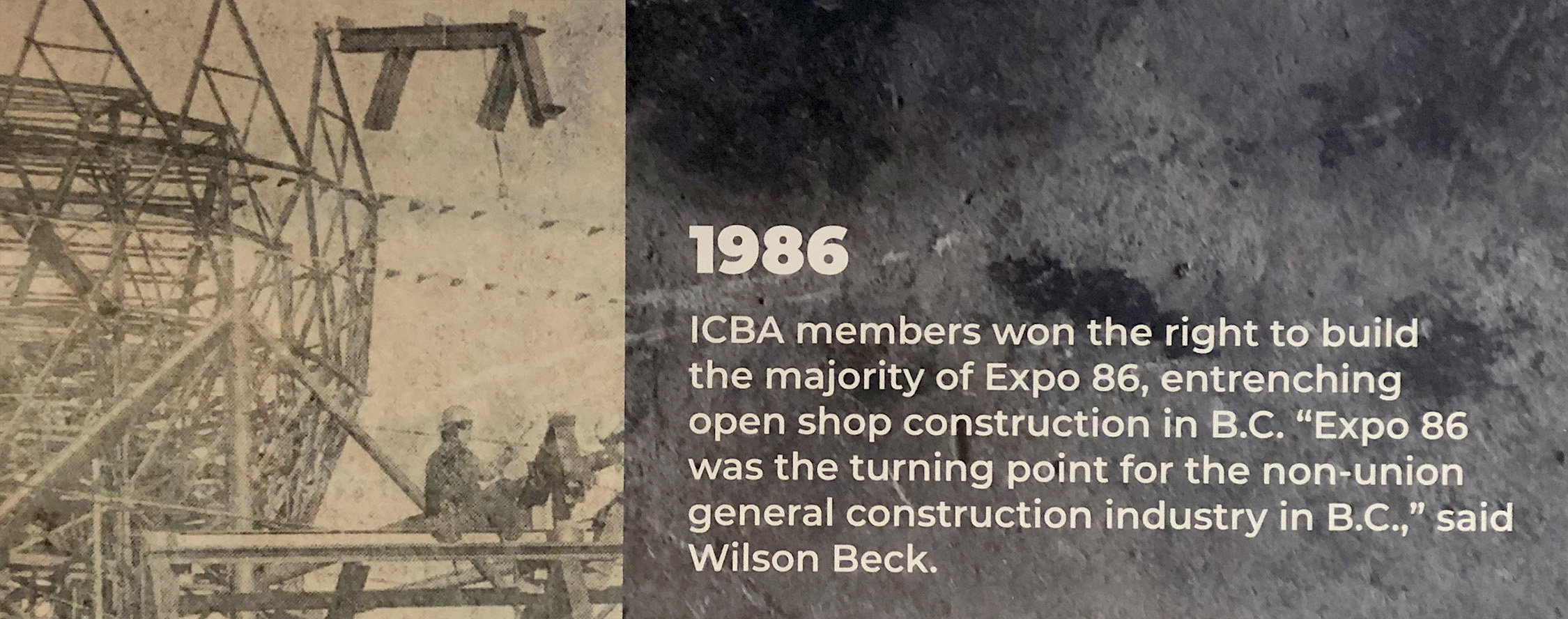
Plaque on ICBA Builders’ Wall commemorating Expo 86.
